Gait Analysis Manchester
Bloc 17, Marble Street
Manchester
M2 3AW
Get directions
Opening hours
Monday–Friday: 8:00 am – 7:00 pm
Saturday: 9:00 am – 1:00 pm
Sunday: Closed

Gait analysis is a clinical assessment of how you walk and run, used to identify movement dysfunction that may be causing pain or limiting performance. At Altius Healthcare, biomechanics and gait analysis is led by Stuart Campbell, a consultant podiatrist and former Team GB athlete with over a decade of experience as an NHS Band 8 lower limb and foot and ankle specialist.
Unlike a high street running shop assessment, a clinical gait analysis at Altius combines hands-on examination with advanced motion analysis technology to pinpoint the underlying cause of your symptoms — not just the visible compensation patterns.
Stuart is a consultant podiatrist who bridges elite sport and general practice. His background includes:

Stuart works with athletes from club level to Olympic and professional standard alongside patients in general practice. His approach draws on his own experience as a competitive athlete and his clinical training to treat each patient with a focus on accurate diagnosis and measurable outcomes.
Book with Stuart at Hale | Book with Stuart at Bury
A gait analysis at Altius is a 45-minute appointment covering clinical assessment, technology-assisted analysis, diagnosis, and a treatment plan. Here is what to expect.
Stuart begins with a detailed history — your symptoms, activity levels, injury history, and goals. A hands-on assessment follows, examining joint range of motion, muscle strength, and structural alignment from the lower back through to the foot and ankle.
The OptoGait system uses infrared sensors to capture precise temporal and spatial gait parameters in real time — stride length, contact time, swing symmetry, and loading patterns during walking, running, and jump tests. This data is reviewed with you during the appointment, so you can see exactly what your gait pattern looks like and where asymmetries or abnormalities are present.
For running assessments and selected walking cases, Stuart also uses the PODOSMART system — an instrumented insole that captures kinetic data during real-world movement rather than on a treadmill alone. This provides pressure distribution, pronation timing, and foot strike data in the environment where your symptoms actually occur, giving a more complete clinical picture.
Once the clinical and technology assessments are complete, Stuart explains the findings in detail and discusses the diagnosis with you. A treatment plan is agreed, which may include custom orthotics, gait retraining, a targeted exercise programme, or a combination. Where necessary, Stuart works closely with your physiotherapist or consultant to coordinate your care.
Most gait analysis clinics rely on a single method — typically treadmill video or pressure plate. At Altius, Stuart uses two complementary systems because each captures different data.
OptoGait provides highly accurate measurements in a controlled clinical environment. It is particularly strong for identifying asymmetry between left and right sides, measuring stride-to-stride consistency, and quantifying changes over time — for example, before and after an orthotic intervention or rehabilitation programme.
PODOSMART captures what happens when you move naturally — outside, on the road, in your own footwear. This is important because gait patterns on a treadmill do not always replicate real-world movement. In-shoe data reveals how forces distribute across the foot during the activities that actually cause your symptoms.
Using both means Stuart can cross-reference findings. If OptoGait identifies a timing asymmetry in your gait cycle, PODOSMART can confirm whether that asymmetry persists — or worsens — during real-world running. This dual approach reduces the risk of basing a treatment plan on incomplete data.
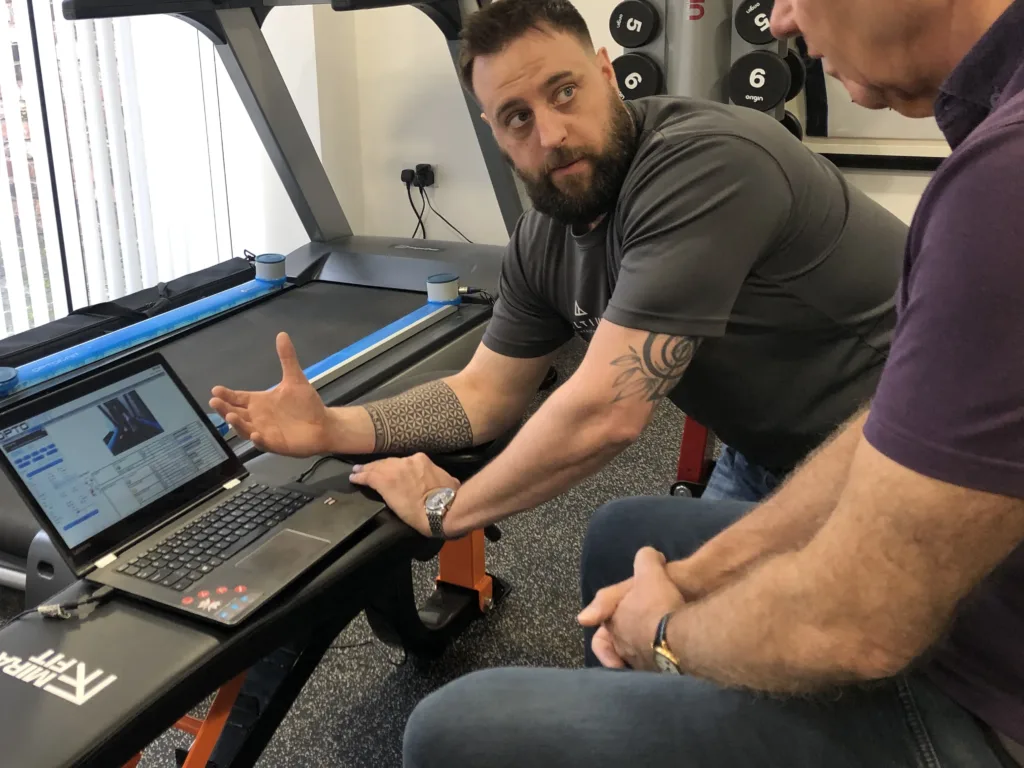
Problems with the way you walk or run can be caused by muscular imbalance, joint restriction, or a structural issue in the foot, ankle, leg, or lower back. Gait analysis is commonly used to investigate and treat:
If you are unsure whether gait analysis is appropriate for your condition, contact us on 0161 401 1000 and Stuart can advise.
A free gait analysis at a running shop typically involves a short treadmill recording to determine whether you overpronate, underpronate, or have a neutral gait. The goal is to recommend an appropriate shoe type. This is useful for choosing footwear but it is not a clinical assessment.
A clinical gait analysis with a specialist podiatrist is a diagnostic process. Stuart examines joint range of motion, muscle function, and structural alignment before any technology is used. The OptoGait and PODOSMART data is then interpreted in the context of your clinical history, symptoms, and examination findings — not in isolation.
Critically, patterns like overpronation are often a compensation for a problem elsewhere in the chain. Simply blocking pronation with a motion control shoe can shift stress to another area. Clinical gait analysis identifies the root cause so treatment addresses the actual dysfunction, not just the visible symptom.
Stuart works with professional and Olympic athletes alongside everyday runners, walkers, and patients in general practice.






Biomechanical Gait Analysis | 45 minutes | £120
Your gait analysis appointment includes:
Gait analysis at Altius is available to self-pay and BUPA patients. If you are insured with another provider, contact us to check coverage.
No. You can book a gait analysis appointment directly with Stuart without a referral. If you have been referred by a GP, consultant, or physiotherapist, please bring any relevant correspondence or imaging to your appointment.
Wear shorts or clothing that allows Stuart to observe your lower limbs clearly. Bring the footwear you normally use for the activity causing your symptoms — for example, your running shoes. If you have existing orthotics or insoles, bring those too.
45 minutes. This includes the clinical examination, OptoGait and PODOSMART analysis, explanation of findings, and discussion of your treatment plan.
Not necessarily. Orthotics are one possible outcome but Stuart may recommend gait retraining, a strengthening programme, or a combination of approaches depending on the findings. The treatment plan is always based on the clinical and technology data from your assessment, not a one-size-fits-all approach.
Yes. Stuart regularly assesses children and adapts the assessment to their age and capabilities. Gait concerns in children — such as in-toeing, flat feet, or growing pains — can often be identified and managed effectively through biomechanical assessment.
No. Gait analysis examines walking as well as running. It is used for anyone experiencing lower limb, foot, ankle, knee, hip, or lower back pain that may be related to how they move — whether that is during sport, at work, or in daily life.
Gait analysis with Stuart Campbell is available at our Hale and Bury clinics. Contact us on 0161 401 1000 to book.
Our biomechanics and gait analysis service is available at our Hale and Bury clinics. Book directly below or contact us to discuss your needs.
Have questions before booking? Call us on 0161 401 1000 or email info@altiushealthcare.co.uk.
Bloc 17, Marble Street
Manchester
M2 3AW
Get directions
Opening hours
Monday–Friday: 8:00 am – 7:00 pm
Saturday: 9:00 am – 1:00 pm
Sunday: Closed
The Old Barn, 30B Park Road
Hale, Altrincham
WA15 9NN
Get directions
Opening hours
Monday–Friday: 8:00 am – 8:00 pm
Saturday: 9:00 am – 1:00 pm
Sunday: Closed
6 Bolton Street
Ramsbottom
Bury
BL0 9HX
Get directions
Opening hours
Monday–Friday: 8:00 am – 7:00 pm
Saturday: 9:00 am – 1:00 pm
Sunday: Closed